Your code, audited. Your mistakes, mastered.
DevAudit is the command center for your engineering work. It watches every push, catches every error, and turns each failure into a written post-mortem with a fix you can apply.
$ devaudit watch --repo acme/storefront
Click a red line to open its autopsy.
TypeError in checkout
132 eventsapi/checkout.ts:48
cart.items[0] is undefined when a guest session expires mid-checkout.
0+
Developers shipping with DevAudit
0+
Monthly dashboard visits
0+
Repositories audited
The product, in motion.
Every screen DevAudit shows your team, looping — from the first push to the finished autopsy.
See what broke, and exactly what changed.
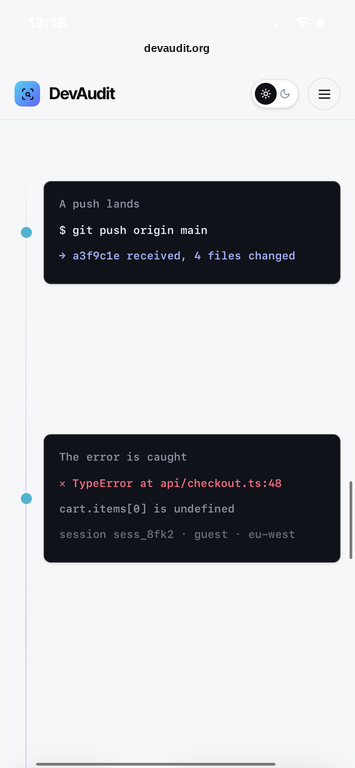
Every push and every error, on one timeline.
An autopsy for every failure, written the moment it happens.
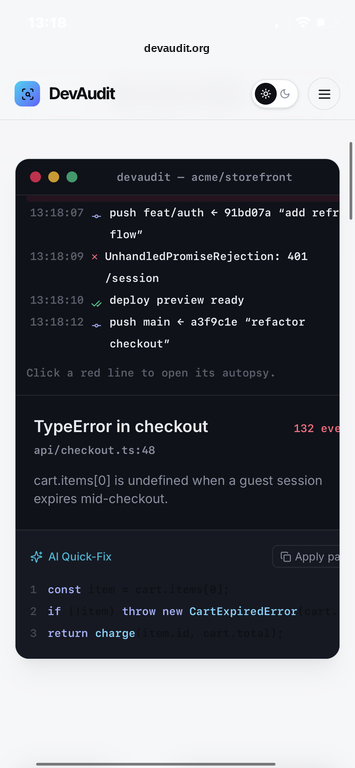
A quick-fix ready to apply, next to the log that found it.
SOC 2, ISO 27001 and live error monitoring, built in.
See what broke, and exactly what changed.
Every push and every error, on one timeline.
An autopsy for every failure, written the moment it happens.
A quick-fix ready to apply, next to the log that found it.
SOC 2, ISO 27001 and live error monitoring, built in.
Everything your team needs to stop repeating bugs.
Two panels of the same dashboard your team opens every day — the live feed, and the fix it hands you.
$ devaudit watch --repo acme/storefront
Every push, watched automatically
DevAudit connects to your repo once, then tails every push and deploy — no dashboards to babysit.
AI Quick-Fix · api/checkout.ts:47
Fixes, explained and ready to apply
Every autopsy ends in a reviewable patch, with the reasoning written next to the line it applies to.
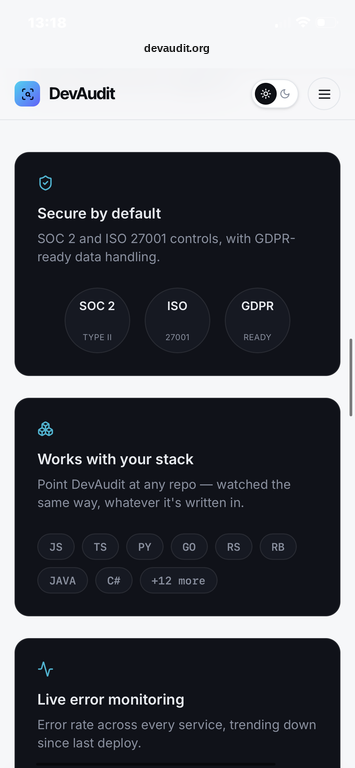
Secure by default
SOC 2 and ISO 27001 controls, with GDPR-ready data handling.
Works with your stack
Point DevAudit at any repo — watched the same way, whatever it's written in.
Live error monitoring
Error rate across every service, trending down since last deploy.
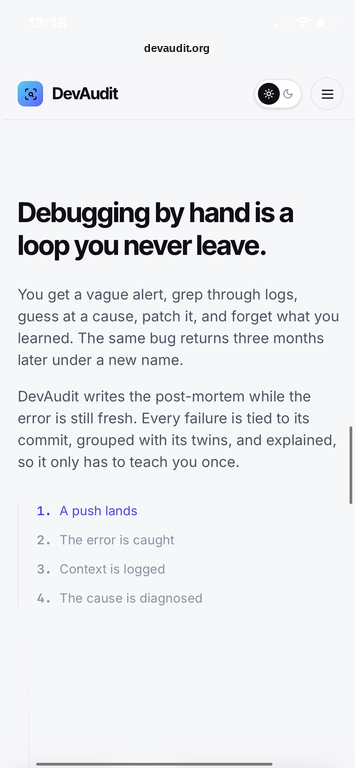
Debugging by hand is a loop you never leave.
You get a vague alert, grep through logs, guess at a cause, patch it, and forget what you learned. The same bug returns three months later under a new name.
DevAudit writes the post-mortem while the error is still fresh. Every failure is tied to its commit, grouped with its twins, and explained, so it only has to teach you once.
- 1.A push lands
- 2.The error is caught
- 3.Context is logged
- 4.The cause is diagnosed
A push lands
$ git push origin main
→ a3f9c1e received, 4 files changed
The error is caught
✕ TypeError at api/checkout.ts:48
cart.items[0] is undefined
session sess_8fk2 · guest · eu-west
Context is logged
✓ linked to commit a3f9c1e by @maya
✓ 132 similar events grouped
✓ first seen 6 min after deploy
The cause is diagnosed
◆ Guest carts expire after 15 min.
◆ checkout() never re-checks the cart.
◆ Patch ready: guard + CartExpiredError
$ devaudit fix --apply
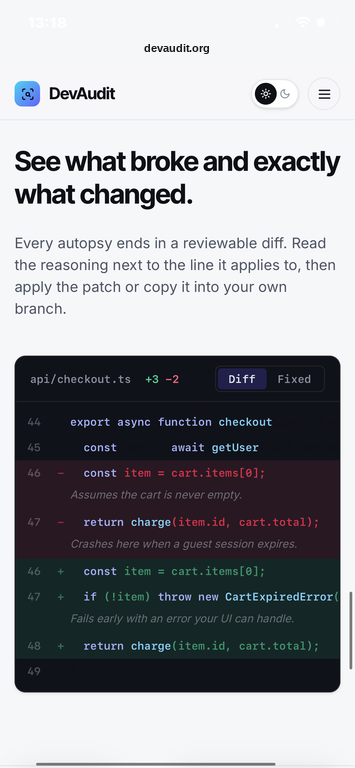
See what broke and exactly what changed.
Every autopsy ends in a reviewable diff. Read the reasoning next to the line it applies to, then apply the patch or copy it into your own branch.
export async function checkout(cart: Cart) {
const user = await getUser(cart.userId);
const item = cart.items[0];Assumes the cart is never empty.return charge(item.id, cart.total);Crashes here when a guest session expires.
const item = cart.items[0];if (!item) throw new CartExpiredError(cart.id);Fails early with an error your UI can handle.
return charge(item.id, cart.total);
}
A patch, not just a warning
DevAudit doesn't stop at the stack trace — it proposes the fix, in your codebase's own style, ready to apply or copy into a review.
Sits in the middle of your stack.
DevAudit doesn't replace the tools your team already relies on — it listens to them.
Teams read fewer stack traces out loud.
What engineering teams say after their first few autopsies.
“We stopped losing Friday afternoons to the same checkout bug. DevAudit had already written the post-mortem before I'd even opened Slack.”
Wherever your team ships from.
Drag to look around — this is where DevAudit's usage is heaviest right now.
Frequently asked questions
Every push and deploy on the repos you connect, plus the errors your services raise afterward — DevAudit links each one back to the commit that likely caused it.